Is AI Making Us Dumb? | Free Report
FREE REPORT
Is AI Making Us Dumb?
What You Can Do to Stay Sharp in the Age of AI
Based on research by Microsoft Research and Carnegie Mellon University
Published at CHI 2025 Conference on Human Factors in Computing Systems
A companion report for the
Critical
Thinking & Problem Solving Skills Course
I want to start with a question that
bothers me.
When was the last time you sat with a problem, really sat with it, before reaching for ChatGPT or Copilot or whatever AI tool sits in your browser tab?
If the honest answer is "I can't
remember," you are not alone.
And that should worry you.
A study published in early 2025 by
researchers at Microsoft Research and Carnegie Mellon University
surveyed 319 knowledge workers who use generative AI at least
weekly.
These workers shared 936 real
examples of how they use AI on the job.
The findings confirmed something
many of us have sensed but didn't want to admit:
"the more we lean on AI, the less we exercise the mental muscles that make us good at our jobs in the first place."
This report breaks down what the
research actually found, why it matters for your career and your
life, and what you can do about it.
Because the solution exists, and it is simpler than you think.
The study, titled "The Impact of
Generative AI on Critical Thinking," was presented at the CHI
2025 Conference in Yokohama, Japan.
The researchers surveyed people who work with AI tools regularly, not casual users, but professionals who rely on these tools for their daily work.
Here is what they found, and I think some of these numbers are worth sitting with for a minute.
|
Finding |
What It Means |
|
60% enaction rate |
Workers only applied critical thinking in about 60%
of their AI-assisted tasks. That means 40% of the time, they accepted AI output without real scrutiny. |
|
Confidence kills scrutiny |
The more someone trusted the AI tool, the less
likely they were to think critically about its output. High AI confidence meant low mental effort. |
|
Self-confidence helps |
Workers who felt confident in their own abilities
were more likely to evaluate AI output carefully. Believing in yourself turns out to be protective. |
|
116 of 319 flagged risks |
Over a third of participants admitted their critical thinking was driven only by fear of negative consequences, not by habit or discipline. |
|
Time pressure is the enemy |
Tight deadlines pushed workers to skip evaluation
entirely. They knew they should check the AI's work, but felt they couldn't afford the time. |
|
The Confidence Trap: Workers who lack
confidence in their own skills trust AI more, even when
they know the AI makes mistakes. This creates a dangerous cycle: the less capable you feel, the more you depend on AI, and the less you develop the skills you need. |
The researchers identified three specific shifts in how knowledge workers approach their tasks when AI is involved.
None of these shifts are inherently bad, but all of them carry risks if you are not paying attention.
Before AI tools, a huge part of
knowledge work was finding things out.
You searched databases, read documents, called colleagues, sifted through data.
That process was slow, but it
forced you to engage with the material.
You built understanding as a side effect of searching.
Now AI does the gathering.
It delivers answers in seconds.
The new skill is supposed to be
verification, checking whether the AI got it right.
But here is the problem:
"verification requires expertise."
You need to know enough about the
subject to spot errors.
If you never built that expertise because the AI always did the legwork, you are stuck trusting output you cannot evaluate.
People used to solve problems step
by step.
Break it down, think through causes, weigh options, pick a path.
That process built mental models of how things work.
With AI, the workflow changes to
prompting and refining.
You describe what you need, the AI
produces a response, and you adjust the output.
The thinking shifts from "How do I
solve this?" to "How do I fix what the AI gave me?"
That is a very different cognitive
exercise.
You still need judgment, but you are no longer building the foundational understanding that comes from working through a problem yourself.
The third shift is from execution to supervision.
Instead of writing the report, you
oversee the AI writing it.
Instead of analyzing the data, you check the AI's analysis.
Supervision sounds like a promotion,
but it is only useful if you have the skills to catch problems.
A supervisor who has never done the
job cannot tell when the job is being done poorly.
The same applies to AI supervision.
If you have not developed deep skills in the work being automated, your supervision is superficial at best.
|
From the Study: The researchers
found that workers often refrain from critical thinking
when they lack the skills to inspect, improve, and guide
AI-generated responses. In other words, the less you know, the more you trust the machine, and the less you learn. |
You might be thinking: so what?
AI is getting better all the time.
Maybe I do not need to think as hard
anymore.
Let the machine handle it.
That argument falls apart for a few reasons.
Generative AI does not know what it does not know.
It produces plausible-sounding text regardless of whether the content is accurate.
If you lack the critical thinking
skills to evaluate the output, you will confidently submit work
with errors you never noticed.
The study found this pattern
repeatedly:
"workers who felt underqualified in a subject put disproportionate trust in AI, even when they knew it was prone to mistakes."
Your brain works like a muscle.
Cognitive abilities you do not exercise weaken over time.
If you stop solving problems
independently, your problem-solving ability declines.
If you stop evaluating arguments,
your ability to spot flawed reasoning fades.
This is not speculation.
It is well-established cognitive
science.
The researchers warned that over-reliance on AI could leave workers with judgment that is, in their words, "atrophied and unprepared."
Here is a thought experiment.
Imagine AI tools disappear
tomorrow.
What can you actually do?
If the honest answer is less than
you could do two years ago, that gap is growing.
The people who will thrive in an AI-saturated world are not the ones who prompt best.
They are the ones who think
best.
AI is a commodity everyone can
access.
Your judgment, your ability to evaluate and decide, that is what differentiates you.

The good news is that critical thinking and problem-solving are skills, not talents.
You were not born with a fixed
amount.
You can build them, sharpen them, and protect them from atrophy.
But you have to do it deliberately, because your environment is now working against you.
Here is what the research suggests, combined with proven methods for strengthening these abilities.
When you face a challenge, spend at
least a few minutes thinking through it on your own before
asking AI.
Write down what you think the
problem is.
List possible causes.
Sketch out a rough approach.
This does not mean never using AI.
It means using your brain first.
The act of struggling with a problem, even briefly, builds neural pathways that passive consumption never will.
One useful technique is pseudocode:
"writing out your plan in plain
language, step by step, before executing."
It forces you to think through gaps,
assumptions, and dependencies.
You see problems in your thinking on paper, which is far cheaper than seeing them in your results.
Logical fallacies are everywhere: in
news, in meetings, in AI output.
The more you can spot them, the
better you evaluate everything around you.
Ad hominem attacks, straw man
arguments, correlation-causation mix-ups, slippery slopes,
appeals to authority.
These patterns show up in AI-generated content just as often as in human arguments, sometimes more.
When you read an AI response, get in
the habit of asking:
a) What assumptions is this making?
b) What evidence supports these claims?
c) Is this actually addressing my question, or is it a well-written non-answer?
One of the biggest traps in problem
solving is fixing symptoms instead of causes.
AI tools make this worse because
they give you quick surface-level answers.
Root cause analysis is a structured
method that asks "why" repeatedly until you get past the
symptoms to the real issue.
The five whys technique, for
example, takes you from "the car part failed" to "our revenue
projections were inaccurate" in five steps.
That depth of analysis is something AI cannot do for you, because it does not understand your specific context the way you do.

The study found that self-confidence is protective against over-reliance on AI.
Workers who believed in their own abilities were more likely to critically evaluate AI output.
A growth mindset, the belief that your abilities improve through effort and practice, is the foundation for this confidence.
This is not motivational fluff.
Research by Carol Dweck at Stanford
showed that people with a growth mindset perform better, persist
longer, and recover faster from failure.
When you believe you can get better
at something, you put in the effort to actually get better.
That effort is exactly what builds the skills AI is threatening to erode.
Critical thinking requires sustained attention, and sustained attention is under siege.
Every notification, every tab,
every context switch, chips away at your ability to think
deeply.
The irony is that AI tools create more noise to process, not less.
Managing focus is now a prerequisite for thinking clearly enough to use AI well.
Practical techniques include:
time-blocking for deep work,
eliminating distractions during
analysis tasks, taking breaks every 45 to 60 minutes, and getting enough sleep.
Your brain uses about 20% of your
body's energy.
Treating your physical health as a cognitive performance issue is not optional anymore.
AI is not going away, and it should
not.
These are powerful tools that save
time and expand what is possible.
But tools that make life easier also
make certain skills feel unnecessary.
That feeling is misleading.
The Microsoft and Carnegie Mellon
research makes one thing clear:
using AI without strong critical
thinking skills is like driving fast without brakes.
It feels great until it doesn't.
The professionals who will succeed in the next decade are the ones who can think independently, evaluate information rigorously, solve problems at their root, and use AI as an amplifier rather than a replacement for their own judgment.
Those skills are not innate.
They are learned.
And they need regular exercise to stay sharp.

|
Ready to Build These Skills? Everything in this report
points to the same conclusion: "critical thinking and
problem solving are the skills that separate people who use
AI well from people who get used by it." These are learnable skills, and there is a structured way to build them. The High-Level Leader Thinking System:
designed for real-world pressure—not theory. Here is what you will learn:
|
|
Module |
What You Will Learn |
|
Problem-solving fundamentals |
A complete method from identifying the right problems to planning, executing, and refining your solutions |
|
Root cause analysis |
The five whys technique and systematic approaches to finding the real source of any problem, not just the symptoms |
|
Critical thinking frameworks |
How to analyze and evaluate information rationally, question assumptions, and resist manipulation |
|
Logic and logical fallacies |
Recognize flawed reasoning in arguments, media, AI output, and your own thinking |
|
Creative problem solving |
Proven techniques for generating original ideas, even if you do not think of yourself as a creative person |
|
Prioritization methods |
Stop doing too much at once. Learn how to identify and focus on the work that actually moves the needle |
|
Growth mindset training |
Build the psychological foundation for confidence and resilience backed by real research, not just motivational slogans |
|
Focus and productivity |
Protect your attention in a world designed to steal it, so you can think deeply when it matters |
You will
not just learn about how to turn yourself into a "Decision
Advantage-High
Level Leader
You will install it these assets and practice until it becomes second nature.
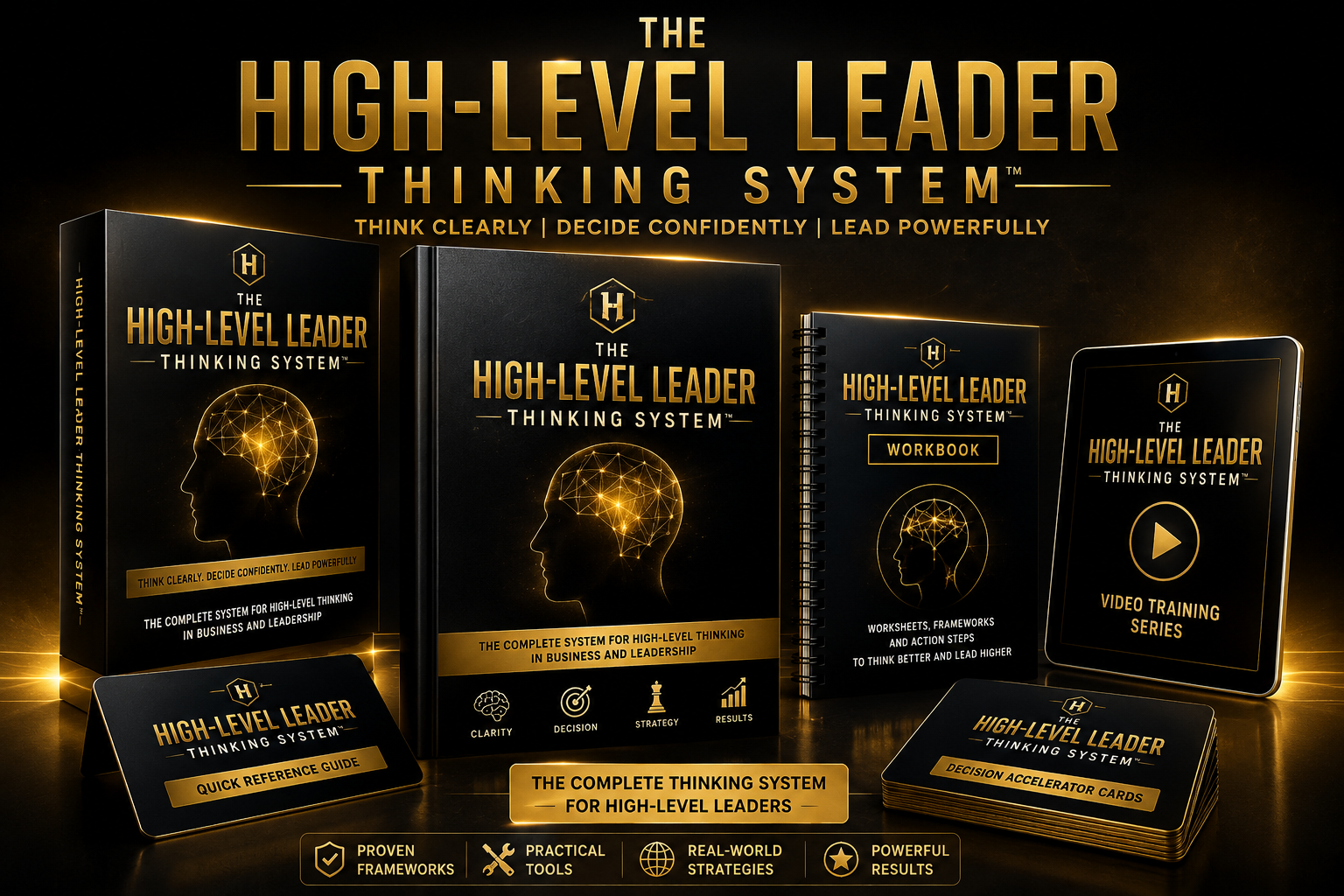
Check out The High-Level Leader Thinking System:
In a
world where AI handles the easy parts, the people who win are
the ones
who can handle the hard parts.
The
High-Level Leader Thinking System builds the skills that
matters most when the machines are doing everything else.
References
Lee, H-P. et al. (2025). "The Impact of Generative AI on Critical Thinking: Self-Reported Reductions in Cognitive Effort and Confidence Effects From a Survey of Knowledge Workers." Proceedings of the 2025 CHI Conference on Human Factors in Computing Systems (CHI '25), Yokohama, Japan. Microsoft Research and Carnegie Mellon University.
Original publication available at: https://www.microsoft.com/en-us/research/publication/the-impact-of-generative-ai-on-critical-thinking-self-reported-reductions-in-cognitive-effort-and-confidence-effects-from-a-survey-of-knowledge-workers/
Terms and
Conditions Privacy Policy
Anti-Spam Policy Service Manifesto
THE-HIGH-LEADER-THINKING-SYSTEM